A thin pool of water like skin coated the surface of the earth. Lying somewhere between the first and second knuckle in depth, it expelled a shallow burbling which seemed to extend endlessly in all directions. Only one continent remained, which had been designated in its entirety as a national park. Towering over the - almost exclusively human - park life stood sheer yet homely ravine faces, beckoning the children of the earth to lean on their abiding sides. Homes, having coevolved with their surroundings, looked rather bare. They took the shape of picnic tables as ordinary as they were open, of the sort made from bent metal arteries and wood planks then affiliated in one body of bench and counter. “Welcome to my home,” we would say, seated and staring emptily at the still air, toes placidly tugged at by a dull current. There was no longer anything left to do.
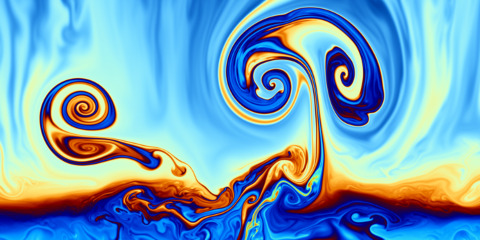
Figure 1. “Mushroom” shape arising in simulated fluid flow from Karl Sims.
The human killers did not reproduce sexually, or indeed at all. Instead they could be said to emerge, practically fully formed, distinctly alive if not yet mature, from the pure flow of water. Infant specimens appeared on the water’s surface as a flat and oily pellicle, no thicker than a soap film yet nearly impossible to puncture. Their shape could be compared to cartoon abstractions of bats if one were to imagine each spiky wing turning in on itself endlessly. As they grew, they would thicken, developing more visible organs: pale blue marble eyes like a blind lobster, and a sleek white body like a scorpion, though without arms. Although each killer looked remarkably similar, it was a point of contest as to the appropriateness of labeling them a species. It was as if each detail of their bodies were evolutionarily mandated, an utterance from a nature utterly conquered, repeating with each birth its last remaining argument.
The human killers, as indicated by their given name, lived as the park human’s sole predator. The blue points of their white tails were lethal, instantaneously so, and yet they were so frail as to hardly be able to hold them up. As they walked, their tails would loll this way and that like an infant’s head. This weakness was in fact the human killers’ greatest gift, as their inability to significantly encroach on the human population absolved them from shortages of prey. Any urgency, which might have motivated a human project to permanently eliminate the killers, was also thus excluded. Instead, the tepid human resistance consisted at most of discarding the filmy infants when noticed, and disturbing any of the antecedent suspiciously shaped currents. Adults too could be neutralized, in an only marginally more dangerous manner, by picking them up from below such that their tails hung powerlessly away from their captors. When so paralyzed, the killers would calmly chide the humans in a deeply resonant voice which seemed to come from inside the listener’s head. “Stop that,” they would comment with the resigned tone of a father chiding a child. There was an understanding between the humans and their predators. More killers would be born, and just as many would be left turned over, stuck on their backs. And so life carried on.